
Context
La Marina Times is the digital newspaper of the Marina Alta, on Spain’s Costa Blanca, focused on Dénia and Xàbia. The area has dozens of sources (local outlets, town hall press notes, regional papers) and readers who speak Spanish, Valencian, English, German, French, Dutch, Italian and Russian. The brief: cover all of it with a minimal team, without copying anyone and without lowering the journalistic bar.
Challenge
- The same story arrives from several outlets, many of them in Valencian, at any hour.
- Write with AI without plagiarising: never reuse third-party text, only use images with rights, always cite sources and label AI-generated content (EU AI Act, art. 50).
- Publish in 8 languages without multiplying the review work.
- Decide what can go out on its own and what needs a person, with rules the editor controls without touching code.
Solution
An editorial pipeline from source to reader. AI does the repetitive work; people decide at the points that matter.
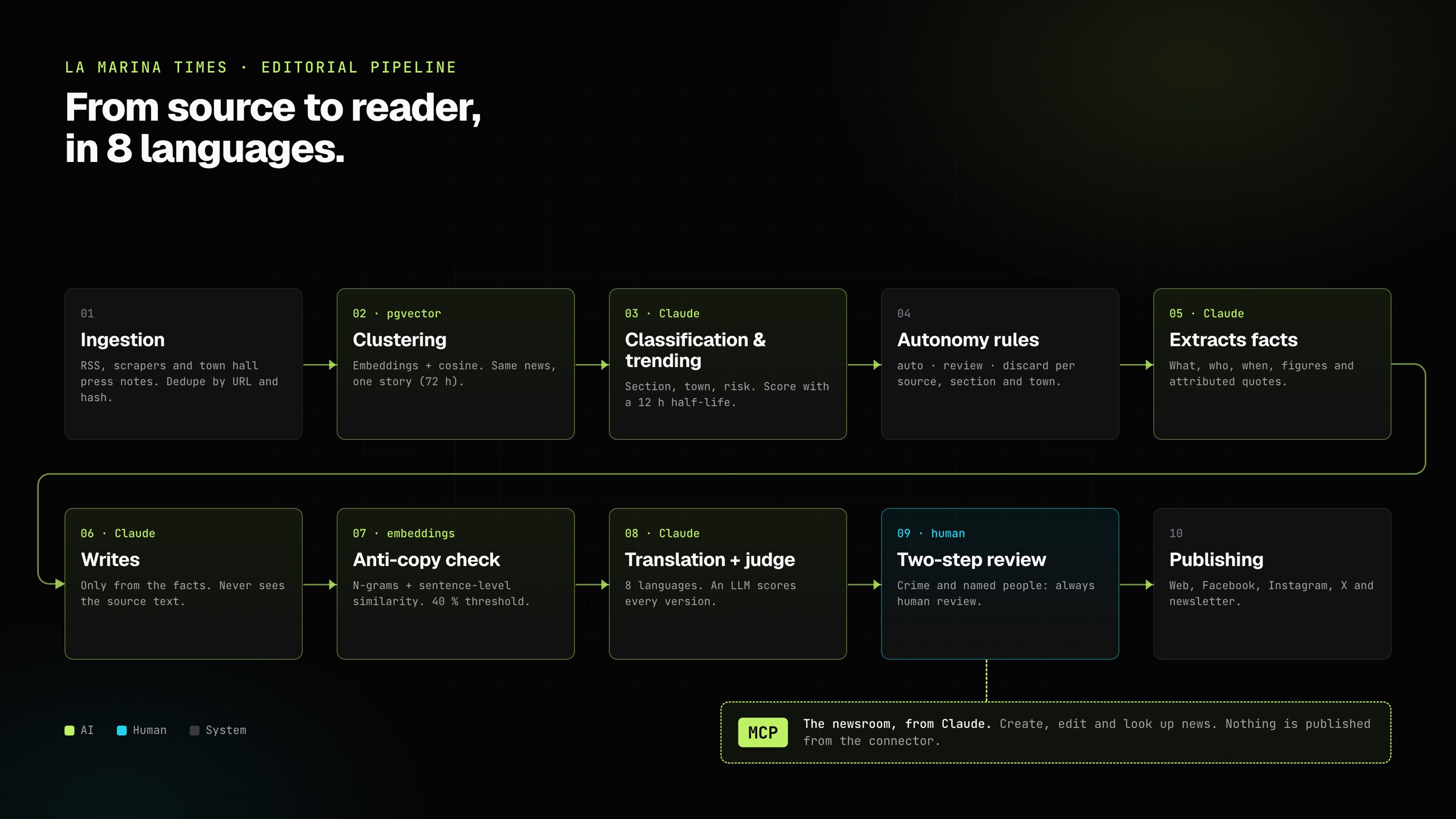
Vector search to tell what is the same story
Every incoming item becomes an embedding (Voyage, 1,024 dimensions) stored in PostgreSQL with pgvector. If it is close enough to a story from the last 72 hours, it joins it; in the grey zone, a fast Claude model confirms whether it is the same event. Five outlets reporting the same thing become one story with five sources, not five articles. pgvector also ranks related articles.
Classification, trending and autonomy rules
Claude classifies every story: section, town, relevance, risk and whether it names people. A trending score blends the most-read lists of the source outlets, comments, number of sources and our own metrics, with a 12-hour half-life. The editor’s rules (per source, section and town) then decide whether a story publishes itself, goes to review or is discarded. Crime and stories that name people always go through a human: no rule can override that.
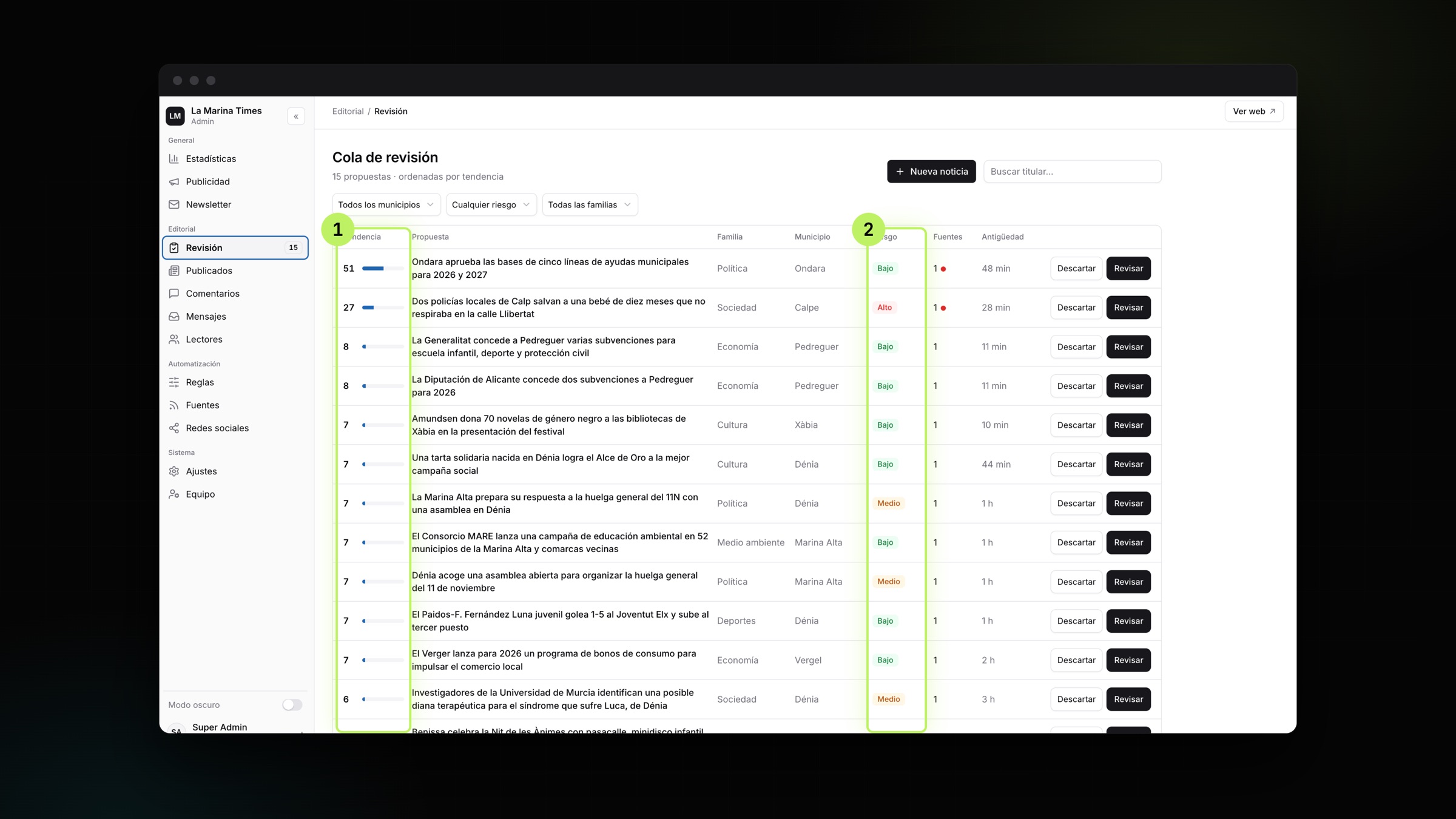 Review queue sorted by trending score (1), with each proposal’s risk (2).
Claude writes from facts, never from the source text
First, Claude extracts the facts from the sources: what, who, when, where, figures and attributed quotes. A separate step then writes the article only from those facts; the writer never sees the source text, and an architecture test enforces it in code. Before review, an automatic check looks for unsupported claims, wrong attributions and lost qualifiers.
Anti-copy check
Every sentence is compared with every source using n-grams and embeddings. Reporting the same fact is fine; reusing the wording is not. Above 40 % similarity the text is rewritten (at most twice) avoiding the flagged sentences, or sent to review.
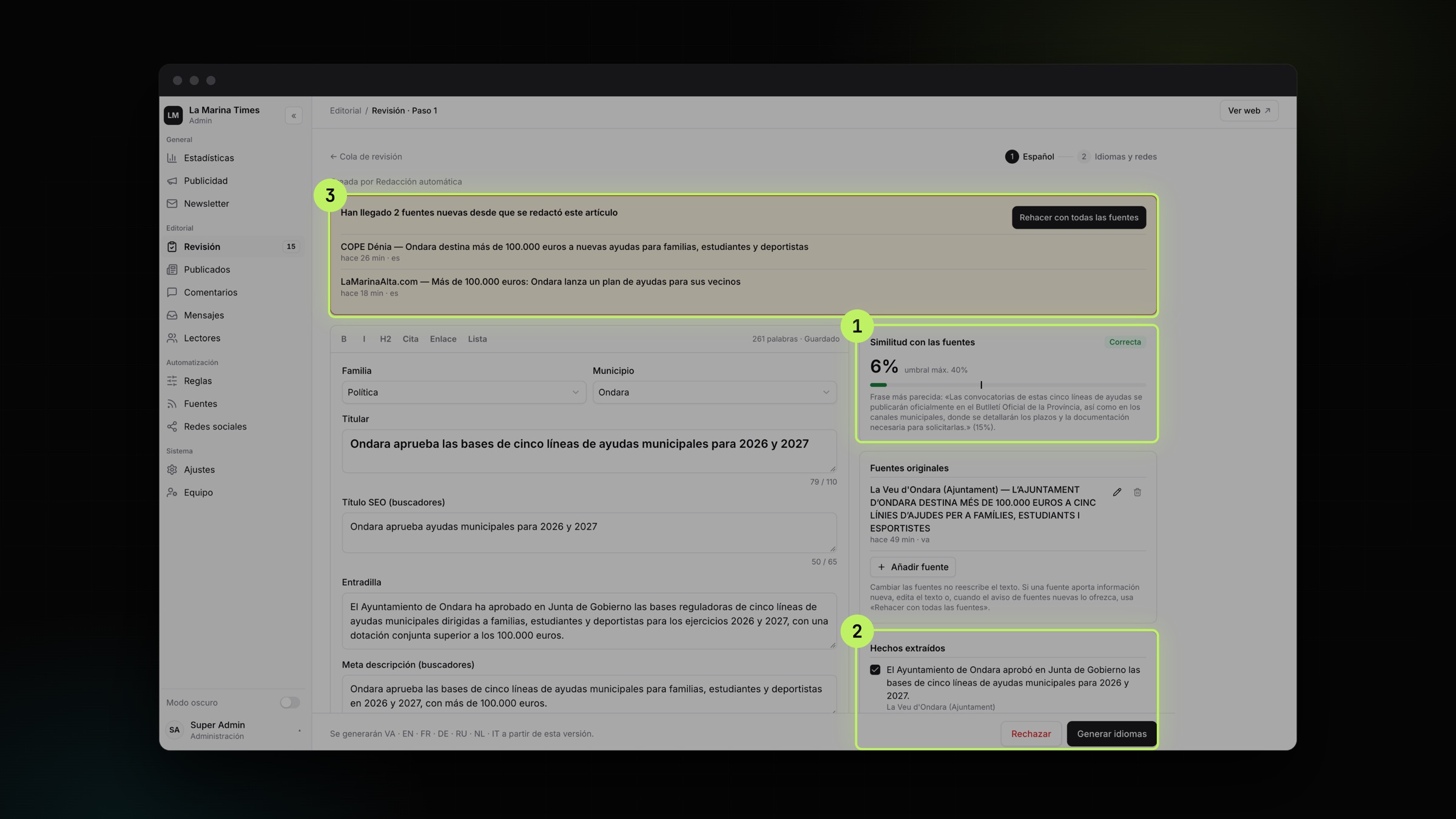 Review step 1: similarity with the sources (1), extracted facts (2) and new sources arriving after drafting (3).
8 languages with a quality judge
Once the Spanish version is approved, Claude translates it into the other languages using each language’s style guide and a glossary of official place names. An LLM judge scores every translation and flags the ones below threshold. Valencian also goes through LanguageTool. In step 2 the editor reviews the languages and the social copy, and picks what gets published.
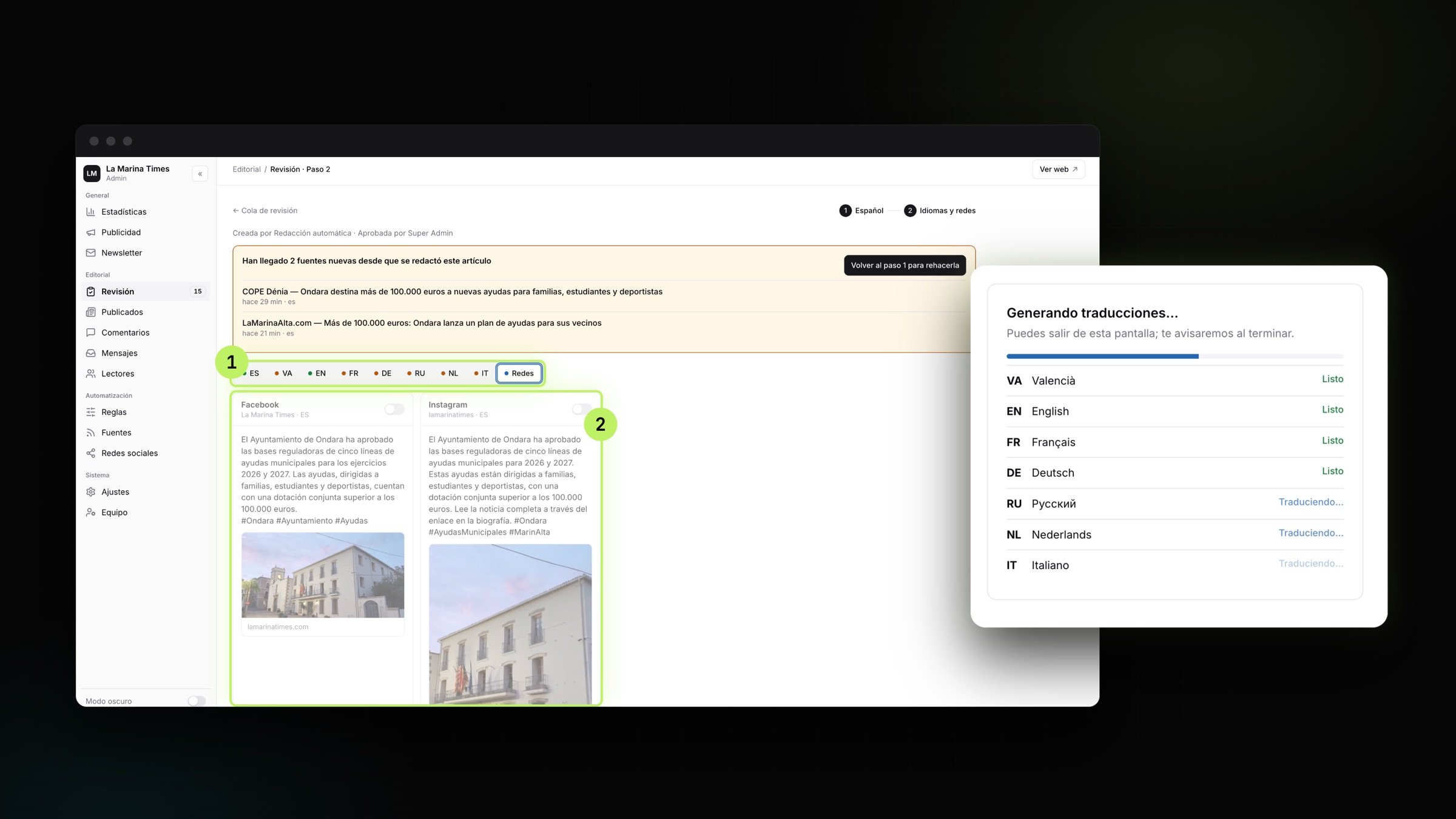 Review step 2: one tab per language (1) and social copy generated per language (2), with translations in progress.
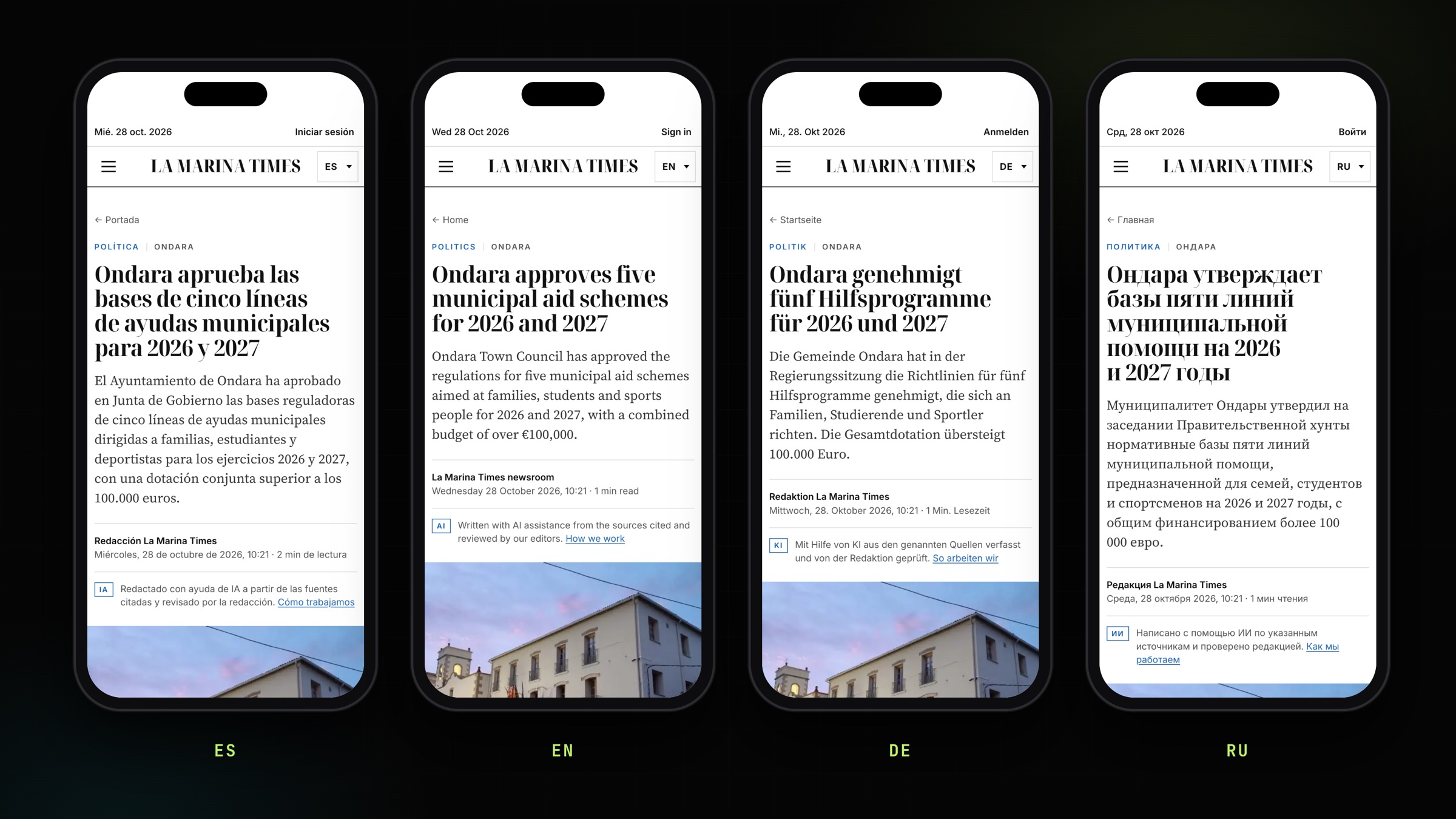 The same article published in Spanish, English, German and Russian.
The newsroom, from Claude too (MCP)
A remote MCP server connects the newsroom to Claude: the editor can file their own stories, add photos, edit items waiting for review (text, SEO, sources, images) and look up what has been published, all from a conversation. It uses the same permissions and validation as the back-office, everything is logged, and nothing is approved or published from the connector.
Distribution and cost control
Each article goes to the web and to Facebook, Instagram and X through their official APIs, with copy per network and language and auto-generated social cards. Plus a newsletter, a Google News sitemap and IndexNow. Every image has an origin and a licence: AI-generated from the facts (never from third-party photos), our own, or a licensed institutional photo with credit. Every AI call goes through a single layer that logs its cost, and prompts are versioned.
Stack
- Backend: Laravel 13 with a domain architecture, Horizon and Redis for queues, scheduler for ingestion and trending.
- Data: PostgreSQL 16 with pgvector for embeddings, clustering and related articles.
- AI: Claude (Sonnet for facts and writing; Haiku for classifying, translating, judging and moderating), Voyage embeddings, gpt-image-1 images, self-hosted LanguageTool for Valencian.
- Web and back-office: Inertia, React 19, TypeScript, Tailwind and shadcn/ui, with SSR for the public site.
- Integrations: MCP server, Meta Graph API, X API v2, Browsershot for social cards.
- Infrastructure: Laravel Forge and S3, with cookieless first-party analytics.